



Disclaimer: The information in this article is for educational and informational purposes only. It does not constitute financial advice, investment recommendations, or a solicitation to buy or sell any assets. Cryptocurrency trading involves significant risk, including the potential for total loss of capital. Always do your own research and consult a qualified financial advisor before making investment decisions.
How to Turn Fear, Greed & On-Chain Data into Rules You Can Actually Trade
Introduction – From “Feeling the Market” to Structured Sentiment Playbooks
Imagine two Bitcoin traders watching BTC rally from $80,000 to $110,000.
- Jack “feels” the move is unstoppable. His Twitter feed is full of “to the moon” posts, group chats are pure FOMO, and everyone is bullish. He ape-longs with leverage.
- Maya opens her sentiment dashboard instead. She checks three things:
- Fear & Greed Index: 87 – Extreme Greed
- Funding rates: strongly positive and rising for a week
- Whales: sending BTC to exchanges
Her sentiment structure screams “danger zone”, so she takes profit and steps aside.
Within 72 hours, BTC corrects sharply to $95,000.
Jack is underwater. Maya is sitting on realized gains.
The difference isn’t luck. It’s structure.
Most traders hear “use sentiment” and translate it into “watch the crowd and bet with/against it”. They end up:
- Chasing vibes instead of trading with rules
- Overreacting to one loud indicator
- Having no written criteria for when sentiment supports, invalidates, or overrides a trade idea
This article fixes that.
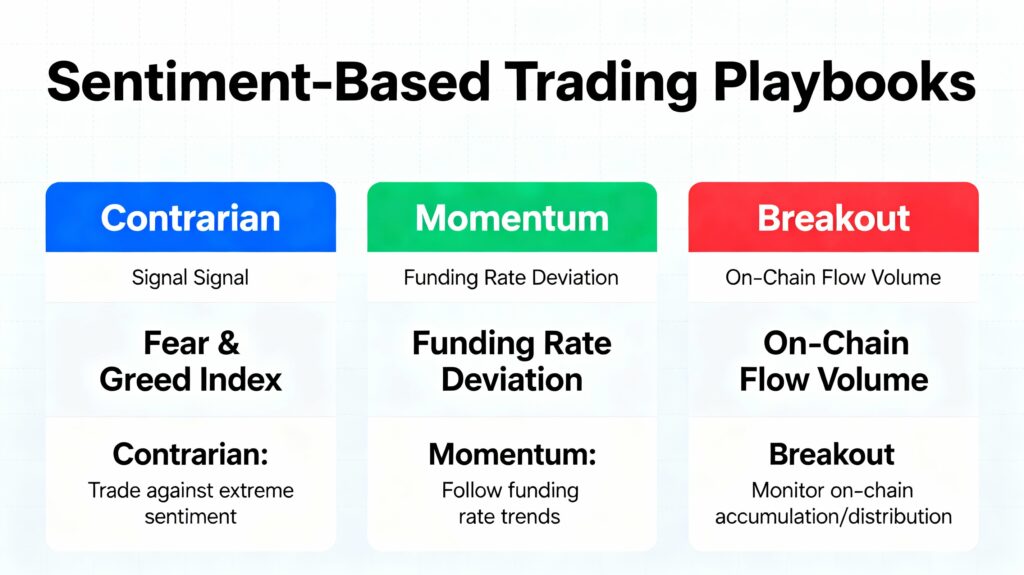
You’ll build three concrete trading playbooks that plug sentiment into real decisions:
- Contrarian Sentiment Fade – Buy fear, de-risk into greed
- Momentum Alignment – Ride trends when sentiment is supportive but not manic
- Breakout Filter – Use sentiment to avoid fake breakouts and stop-hunts
Each playbook includes:
- Which sentiment signals matter
- Thresholds that trigger action
- Price action confirmation rules
- Simple IF/THEN templates you can backtest, code into a bot, or trade manually
Important: This is a framework, not financial advice. Your job is to test, adapt and size it to your own risk tolerance.
Quick Recap – The 3 Crypto Sentiment Pillars (2-Minute Refresher)
Before we talk strategy, anchor everything to these three sentiment pillars. Almost every tool you use will fall into one of them.
Pillar A – Social & Narrative Sentiment
What people are saying and feeling:
- X/Twitter, Reddit, Telegram, Discord, news, YouTube
- Fear & Greed Index (0–100: 0–24 = Extreme Fear, 75–100 = Extreme Greed)
- Tools: LunarCrush, Santiment, Alternative.me
When social sentiment is extreme, it often reflects retail FOMO or panic, not calm analysis.
Pillar B – Derivatives & Positioning
How traders are betting with money:
- Perpetual futures funding rates (positive = longs pay shorts; negative = shorts pay longs)
- Open interest (total size of open futures positions)
- Liquidations and liquidation “clusters” / density
- Tools: CoinGlass, CryptoQuant, exchange derivatives dashboards
Derivatives tell you where the market is crowded, and where squeezes are likely.
Pillar C – On-Chain & Flows
What big money is actually doing:
- Exchange inflows/outflows (sell pressure vs accumulation)
- Whale accumulation/distribution
- Stablecoin flows (buying power moving in/out)
- Realized profit/loss
- Tools: Nansen, Glassnode, CryptoQuant
On-chain is slower but harder to fake. It shows conviction from large holders.
How the 3 Playbooks Weight the Pillars
| Playbook | Primary Pillars Used | Purpose |
|---|---|---|
| Contrarian | All 3 at extremes | Fade panic/euphoria at major turning points |
| Momentum | B + C supportive, not max | Ride trends when sentiment is aligned but healthy |
| Breakout Filter | B + C at key levels | Filter real breakouts from stop-hunt traps |
Playbook #1 – Contrarian Sentiment Fade
(Extreme Fear & Extreme Greed)
Objective
Buy when everyone is capitulating, de-risk when everyone is euphoric. You’re trading sentiment extremes at key price levels.
Why It Works
Markets overshoot in both directions. When:
- Retails panic
- Sentiment collapses
- Leverage is flushed
- Whales quietly accumulate
…the risk–reward often flips in your favor.
Likewise, when:
- Fear & Greed is in Extreme Greed
- Funding is heavily positive
- Social media is full FOMO
- Whales are sending coins to exchanges
…late buyers are paying top dollar to become exit liquidity.
Long Entry Rules – Extreme Fear Setup
You want all conditions (or at least most) aligned:
- Price Structure (Non-negotiable)
- BTC/ETH at or near a major support (daily/weekly level, prior swing low, round number, or long-term trendline).
- Without structure, you’re just buying a falling knife.
- Sentiment Extreme (Fear)
- Fear & Greed Index < 20 → “Extreme Fear”.
- Historically tied to capitulation phases.
- Funding Compression
- Funding rates negative or near zero.
- Leverage longs have been flushed; shorts are comfortable.
- On-Chain Confirmation
- Whales net accumulating (not selling).
- Exchange outflows > inflows or at least inflows slowing.
- Signals belief that current lower prices are attractive.
- Price Action Trigger
Only after 1–4 align:- Hammer candle off support
- Long wick below support that reclaims the level
- Break of a short-term resistance (previous day’s high, 4H swing high)
This final trigger prevents you from jumping in while the knife is still falling.
De-Risk / Exit Rules – Extreme Greed
You don’t hold blindly. Use these to scale out:
- Fear & Greed > 80 (Extreme Greed)
- Funding strongly positive for multiple periods (e.g., >0.05% per 8h repeatedly)
- Social mania – “ATH soon”, “never going down”, memes everywhere
- On-chain distribution – whale inflows to exchanges spike
Action plan:
- 2 signals → Take 30–50% profit, tighten stops
- 3–4 signals → Exit most or all; leave a small “runner” only if trend is incredibly strong
Worked Example – BTC Crash & Bounce
- BTC nukes from $97k → $80k
- Fear & Greed: 18
- Funding: -0.02% (shorts dominant)
- On-chain: whales accumulate ~5,000 BTC, exchange inflows slow
Price prints a hammer off $79.5k and closes above $81k with strong volume.
- Entry: Long at $81k, stop below $78.5k (structural support break invalidates).
- BTC rallies to $100k.
- Fear & Greed: climbs into the 80s
- Funding: +0.08%
- Whales: sending BTC to Binance
You:
- Close 50% at $100k
- Trail stop on rest at $98k
If it runs higher, you win more. If it reverses, you protected the bulk of the gain.
Risk Management Rules for Contrarians
- Risk 1–3% of account per trade, max
- Never ignore structure because “sentiment is perfect”
- Demand multiple confirming signals (not one outlier)
- Backtest across several crashes and cycles to understand win rate and drawdowns
Playbook #2 – Momentum Sentiment Alignment
(Ride Trends, Don’t Fight Them)
Objective
Trade with established trends when sentiment is:
- Supportive
- Aligned with direction
- But not yet in blow-off euphoria
Momentum = “go with the flow — but only when the current is clean”.
Why It Works
Momentum fails when:
- You trade it in a range, or
- You trade too late, after euphoria peaks
By using sentiment as a filter, you:
- Stay out during choppy noise
- Avoid early exits from strong trends
- Avoid chasing at the top
Long Entry Rules – Momentum Setup
- Trend Structure
- Price above 200-day MA
- Clear pattern of higher highs + higher lows on daily chart
- Funding in the “Safe Zone”
- Funding between 0% and 0.05% per 8h
- Slight long bias = healthy trend
- Below 0% = market still fearful (contrarian setup instead)
- Above ~0.08% = crowded longs; risk of squeeze
- Sentiment: Neutral to Mildly Bullish
- Fear & Greed in 40–70 range
- Not panic, not mania → “healthy optimism”
- On-Chain Neutral or Positive
- Exchange flows neutral or showing modest outflows
- No major whale distribution spike
- You don’t need extremes, just no big red flags
- Technical Trigger
- Break above previous swing high with volume, or
- Retest of support (e.g., 20-day MA) with bullish candle closing strong
Scaling & Exits
Add to winners when:
- Price continues printing higher highs
- Funding stays in the safe zone
- Fear & Greed remains 40–70
- On-chain remains neutral or mildly accumulation-biased
De-risk or exit when:
- Funding > 0.08% for several periods
- Fear & Greed > 75–80
- Whales start depositing to exchanges
- Price breaks 200-day MA or forms a clear lower low
ETH Example – Riding a Healthy Trend
- ETH rallies from $3,000 → $3,500
- Above 200-day MA, higher lows forming
- Funding: +0.03%
- Fear & Greed: ~55
- On-chain: whales mostly holding, no big exchange inflows
You:
- Enter around $3,500 on breakout
- Add on dips to 20-day MA as long as sentiment structure stays intact
- Ride move towards $4,000 and beyond
- Exit or trim only as funding and F&G near extreme levels
Bot-Friendly Rule Template (Momentum)
IF (price > 200-day MA)
   AND (structure = higher highs + higher lows)
   AND (funding between 0% and 0.05%)
   AND (Fear & Greed between 40 and 70)
   AND (exchange inflows <= outflows OR neutral)
THEN
   allow long entries on breakout / MA retest
ELSE
   no new long entries
This keeps your bot out of chop and out of euphoric tops.
Playbook #3 – Breakout Sentiment Filter
(Avoid Fakeouts, Trade Only “Real” Breakouts)
Objective
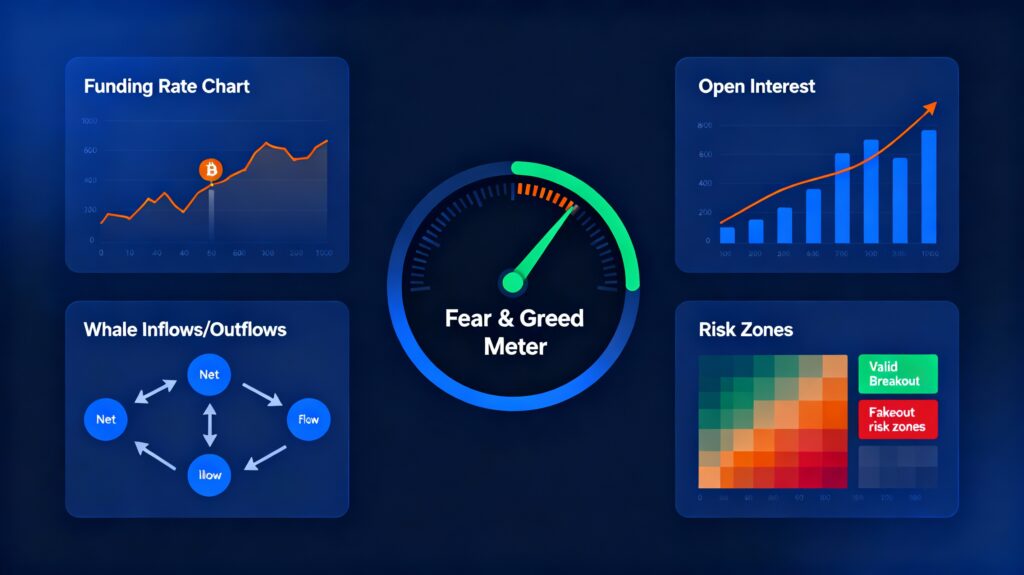
Only trade breakouts when sentiment + leverage + flows say the move is real, not just a stop-hunt.
Why It Works
Most breakouts fall into two buckets:
- Valid breakout: real demand, rising open interest, sustainable funding
- Trap breakout: thin liquidity, FOMO leverage spike, whales selling into strength
Sentiment and derivatives data help you tell them apart.
Valid Breakout Checklist (Long)
You want most of these:
- Price Close Above Resistance (Not Just Wick)
- 4H or daily candle closes above a well-defined resistance level
- Volume is above average (real participation)
- Open Interest Rises with Price
- OI increases steadily during/after breakout
- Shows new positions entering, not just short covering
- Funding Rises, But Not Explodes
- Moves from neutral → mild positive
- Roughly 0.02%–0.06% per 8h range
- Social Sentiment Up, Not Mania
- Buzz increases, more mentions & interest
- Fear & Greed in 50–75, not jumping straight to 90+
- Whales Not Dumping into the Level
- Whale deposits to exchanges do NOT spike at breakout
- If they do, it’s likely distribution, not breakout conviction
Trap / Fakeout Warning Signs
- Long wick above resistance, candle closes back below
- OI and funding spike in 1–2 candles (leverage blow-off)
- Fear & Greed already at 85–90+ before breakout
- Whales send a large amount of BTC/ETH to exchanges right around the breakout
- Volume declining into breakout, not expanding
BTC at $100k – Two Scenarios
Scenario A – Real Breakout
- BTC grinds up, tests $100k
- F&G ~60–70
- Funding: +0.03%
- OI steady, then rises with breakout
- Whale flows neutral
Price closes above $100,050 on strong volume.
→ You take the breakout: long at $100,075, stop below $99,500.
Scenario B – Trap
- BTC rockets to $101k in one savage candle
- OI jumps $4B in an hour
- Funding spikes from +0.02% → +0.12%
- F&G already 86, jumps to 92
- Whales send 1,200 BTC to exchanges
Price later closes back below $100k.
→ You skip the long. Maybe even look for a short after confirmation.
Breakout Rule Template
IF (price closes above key resistance on strong volume)
   AND (open interest increasing with price)
   AND (funding between 0.02% and 0.06%)
   AND (Fear & Greed <= 75)
   AND (no spike in whale deposits to exchanges)
THEN
   enter breakout long, risk 2% of account
   stop just below broken resistance
ELSE
   treat as likely fakeout, no long
Turning Playbooks into Simple, Testable Rules
Sentiment only becomes an edge when it’s structured.
Example Rule Sets
Contrarian Long Entry
IF (price within ~2% of key daily/weekly support)
   AND (Fear & Greed < 20)
   AND (funding <= 0% OR slightly negative)
   AND (whales net accumulating OR exchange outflows > inflows)
THEN
   wait for bullish price action trigger (hammer, wick reclaim, or 4H high break)
   enter long, risk 1–2% of capital
   stop below structural support
Momentum Long Entry
IF (price > 200-day MA)
   AND (higher highs + higher lows on daily)
   AND (funding 0%–0.05%)
   AND (Fear & Greed 40–70)
   AND (exchange inflows <= outflows OR neutral)
THEN
   enter on breakout or MA retest
   risk 2–3% per trade
   add only while all conditions stay true
Breakout Entry
IF (daily or 4H close above key resistance with strong volume)
   AND (OI increasing with move)
   AND (funding 0.02%–0.06%)
   AND (Fear & Greed <= 75)
   AND (no whale deposit spike)
THEN
   enter breakout
   stop just below new support
   take profit at next major resistance or if funding/F&G/flows flip bearish
Common Mistakes When Mixing Sentiment & Strategy
1. Using Contrarian Logic in a Healthy Trend
- Mistake: Shorting every pump because “it’s too high”.
- Fix: Only use contrarian rules at extremes (F&G <20 or >80 + multiple confirming signals). In a strong trend with F&G 60 and funding +0.03%, momentum rules are more appropriate.
2. Using Momentum Rules in Choppy Ranges
- Mistake: Attempting “breakouts” inside a tight $95k–$97k range.
- Fix: Confirm trend first: price > 200-day MA and multiple higher highs + higher lows. If not, use contrarian or breakout-only playbooks.
3. Overfitting Rules to One Crash or One Cycle
- Mistake: Optimizing thresholds to one perfect backtest.
- Fix: Backtest sentiment rules across multiple regimes (bull, bear, sideways, macro shocks). Accept that any edge wins over many trades, not every single one.
4. Ignoring Position Sizing Because “Setup is Perfect”
- Mistake: Going 10% risk because all signals line up.
- Fix: Keep risk per trade low (1–3% max). Even A+ setups fail. Your sizing must assume you can be wrong multiple times in a row.
FAQs
Q: Can I use all three playbooks at the same time?
A: Not on the same asset and timeframe. Use one playbook per trade. You can shift playbooks as market regimes change (e.g., Contrarian during crash, Momentum during trend, Breakout near key levels).
Q: How many sentiment metrics do I really need?
A: Start with 5 core metrics:
- Fear & Greed (A)
- Funding (B)
- Open Interest (B)
- Whale flows (C)
- Exchange inflows/outflows (C)
That gives you coverage across all 3 pillars without paralysis.
Q: What timeframe should I use for sentiment?
A: Treat sentiment as slow context:
- Fear & Greed: daily
- Funding/OI: every 8h / 4H blocks
- On-chain: daily/weekly
Use faster price charts (4H, daily) for entries.
Q: Does this work on small-cap altcoins?
A: Data for pillars B & C is often incomplete for microcaps. These playbooks are most reliable for BTC, ETH and large caps. For small caps, you’ll rely more on social + volume/liquidity than deep on-chain analytics.
Q: How often should I update my rules?
A: Review every quarter. Markets evolve. Adjust thresholds only after reviewing a decent sample of trades, not after one bad week.
Conclusion – Pick One Playbook and Master It
Sentiment isn’t a magic “buy/sell” button. It’s a context layer that, when combined with price action and risk management, helps you:
- Avoid being exit liquidity in euphoric tops
- Avoid panic-selling at cycle bottoms
- Stay longer in trends that genuinely have fuel
Your roadmap:
- Pick your playbook:
- Contrarian: You like deep discounts and can emotionally handle buying when others panic.
- Momentum: You prefer to go with the crowd while the trend is healthy.
- Breakout: You enjoy tactical entries around key levels and hate fakeouts.
- Write your rules down.
Use specific thresholds (e.g., “Fear & Greed < 20”, not “very low sentiment”). - Paper trade for 4 weeks.
Track every signal, entry and exit. See where rules helped or where you broke them. - Trade small for 20–30 real trades.
Only then decide whether to size up or refine. - Only after mastering one, consider adding another.
The traders who survive and grow are not the ones with the most indicators.
They’re the ones with one clear, tested playbook they execute with discipline.
Build yours. Refine it. And let sentiment serve you as structured data—not as noise.
Discover more from aiCryptoHub.io
Subscribe to get the latest posts sent to your email.